 Xognosis EsotericaArcane Publishing Studio
In the autumn of 1570 a Bologna professor of medicine in his late sixties was arrested by the Roman Inquisition, held until late December, and made to post a bond of 1,800 gold crowns.

Share
In the autumn of 1570 a Bologna professor of medicine in his late sixties was arrested by the Roman Inquisition, held until late December, and made to post a bond of 1,800 gold crowns. He had published a horoscope of Christ, taught divinatory superstitions, and spent roughly thirty years recording his own dreams to test whether they told him the future. He had also, decades earlier, written the first sustained mathematical analysis of gambling, a century before Pascal and Fermat turned chance into a science. The prisoner's name was Girolamo Cardano, and the three facts belong to one life.
Cardano was born in Pavia on 24 September 1501 (his autobiography says 1500, but modern references accept 1501), took his medical doctorate at Padua in 1525, and spent much of his career lecturing in Milan, Pavia, and finally Bologna. Medicine paid badly at the start. In his autobiography he admitted the coping mechanism plainly: "From my youth, I was immoderately given to gambling; and in this way I became known to Francesco Sforza, a prince of Milan, and made many friendships for myself among the nobles." For the excuse he offered nothing better than "the poverty of my early life, a certain shrewdness in hazards, and something of skill in play."
The habit was serious. "I gambled at both for many years," he confessed, "at chess more than forty years, at dice about twenty-five; and not only every year, but ... every day, and with the loss at once of thought, of substance, and of time." Sixteenth-century Italy had no casinos; he played dice, cards, and chess in private houses among noblemen. But a daily gambler who is also a brilliant mathematician eventually starts counting. Sometime around 1563, after years of accretion, he completed in manuscript a treatise called Liber de Ludo Aleae, the Book on Games of Chance. It went unprinted in his lifetime and only appeared in 1663, in the ten-volume Lyon edition of his collected works.
The treatise's sixth chapter states what Cardano called the principal foundation of dice: "Est autem omnium in Alea principalissimum aequalitas," the chief thing of all in dicing is equality, of opponent, bystanders, money, place, dice box, and the die itself. However far you depart from that equality, against yourself you are a fool, and in your own favor you are unjust. Elsewhere he worked out the one-die calculation, the equal share of the six faces that lets two players strike a fair agreement, and he claimed to have explained why "a thousand dice in a thousand throws, if the dice are not loaded, necessarily cast one ace." Oystein Ore's classic study and David Bellhouse's 2005 analysis establish what this means: the first serious mathematics of probability, with gaps, written a hundred years ahead of the French correspondence that usually gets the credit. The same treatise also covers effective cheating methods, because Cardano knew that side of the table too. His own summary of why he wrote it has a gambler's shrug: "why should not a man who is a gambler, a dicer, and at the same time an author, write a book on gaming?"
The opening of the Inquisition archives in the 1990s is what changed the story of the arrest. The traditional account holds that Cardano was imprisoned for casting and publishing the horoscope of Christ in his astrological commentary. That story is wrong, or at least incomplete. The Stanford Encyclopedia of Philosophy, drawing on the opened archives, puts it this way: "It was not Christ's horoscope that led directly to Cardano's trial." The trigger was a denunciation by the Inquisitor of Como aimed at De rerum varietate (1557), with charges that he exaggerated celestial influence, denied God's direct action on the world, held the martyrs to be madmen, and taught divinatory superstitions. The horoscope had been published and it hung over the affair, but the dossier was broader.
The dates are firm. Arrested 6 October 1570, released 22 December, transferred to house arrest, and in February 1571 abjured, in the Encyclopedia's wording, "not as a formal heretic, but rather as vehemently suspected of heresy." He lost the Bologna chair after Inquisition pressure on the city government, moved to Rome in October 1571, and saw his non-medical works placed on the Index of Prohibited Books the following year. He wrote his autobiography in Rome in 1575 and 1576, and died there on 21 September 1576. A popular tale that he starved himself to fulfill his own predicted death date appears in none of the standard sources and should be treated as legend, if repeated at all.
By then he had already survived a worse catastrophe. His eldest son Giovanni Battista, born in 1534, married Brandonia di Seroni in 1557 against his father's will. The autobiography records what followed: the son "had been accused of attempting to poison his wife while she was still in the weakness attendant upon childbirth. On the 17th day of February he was apprehended, and fifty-three days after, on April 13th, he was beheaded in prison." Cardano added one sentence: "And this was my supreme, my crowning misfortune." He numbered it among his four calamities, alongside his marriage, his imprisonment, and the character of his youngest son Aldo, whom he was "obliged to have him imprisoned more than once, to condemn him to exile, and to cut him off from his paternal inheritance."
Long before the arrest, Cardano had begun keeping watch on his own sleep. By his own count the practice ran about thirty-three years, from roughly 1534 to 1567: "A few years later, eight perhaps, that is, about 1534, I began to see in my dreams the events shortly to come to pass," and the manifestation "ceased ... about 1567." These claims are his testimony about himself, not independently verified events, and they are best read that way. Some are striking. He reports dreaming of a cock more than a hundred times, fearing it would speak, and later dreaming it did. He reports the image of a bloody sword appearing on his ring finger the evening the arrest letters for his son arrived, rising along the finger for fifty-three days, and blazing "a blood-red flame" at the tip on the night of the beheading. The count of days matches the execution date, which is either the strangest detail or the most careful one.
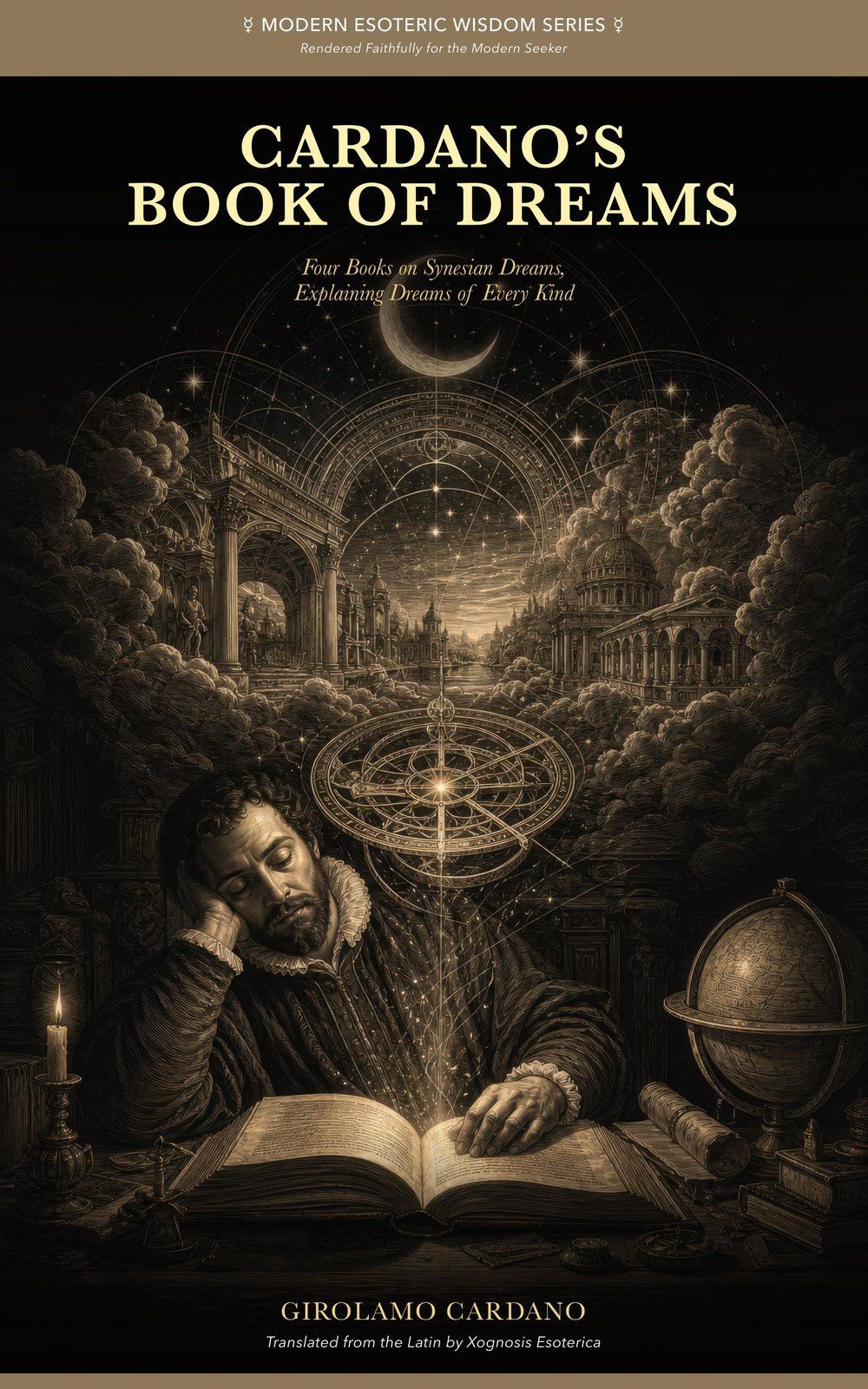
In 1562, twenty-eight years into the dream life, he published the result: Somniorum Synesiorum libri IIII, four books on dreams, printed at Basel by Henricus Petri. The title honors Synesius of Cyrene, who had urged people to record their dreams; Cardano noted that Synesius wrote no art of interpretation, so the name credits a method rather than a source text. The book surveys earlier writers from Artemidorus onward, offers a theory of how dream images arise, classifies dreams, and gives advice on reading them, as Alice Browne's 1979 study and Anna Corrias's 2018 analysis describe. Book IV contains fifty-five of Cardano's own dreams recounted in unusual detail. A modern critical edition with French translation appeared in 2008; readers of English now have Cardano's Book of Dreams, a complete translation from the 1562 first edition.
Cardano worked out why the honest die and the loaded die pay differently, and he also kept a thirty-year diary of a cock that spoke and a sword that rose on his finger. The mathematics and the dreams come from the same hand, and neither half of the man makes full sense without the other.
He put his own case best in the prologue to the autobiography: "My autobiography, however, is without any artifice; nor is it intended to instruct anyone; but, being merely a story, recounts my life, not tumultuous events." The events were tumultuous enough.
Read the book
Related Articles
Continue through articles sharing this topic.
In the summer of 1552, two of the most restless minds in Europe were, as far as anyone can tell, in the same city at the same time.
6 min read
In 1936, C. G. Jung began a seminar in Zurich on children's dreams. Over the following years it grew into something larger: a survey, delivered to a circle…
6 min read
You wake with an image in your head: a staircase, a stranger's face, an eclipse. Days later something happens and the image seems to have known it first.
7 min read
Sometime in 1547, in the Lombard city of Pavia, a quarrelsome professor of medicine went to sleep and did what almost no one in Europe did in 1547: he wrote…
6 min read