 Xognosis EsotericaArcane Publishing Studio
In 1677 a small book left a press in the Huguenot port of La Rochelle and said almost nothing. The Mutus Liber, or "silent book," was composed principally of engraved plates, a sequence of pictures where other alchemical works pour out pages of instruction. Its print run was tiny, a few dozen copies at most.
Share
In 1677 a small book left a press in the Huguenot port of La Rochelle and said almost nothing. The Mutus Liber, or "silent book," was composed principally of engraved plates, a sequence of pictures where other alchemical works pour out pages of instruction. Its print run was tiny, a few dozen copies at most. Twelve originals survive in major Western libraries. And yet this near-invisible object has never stopped producing interpretation, precisely because it refuses to say what it means. When a book speaks only in images, the reader must do the talking.
The little volume does name an author and an inventor. The first is "Altus," described in the book's own framing as a scholar in high chemistry of Hermes. The second is Jacob Saulat, sieur des Marez. As the French Wikipedia article puts it, "although these statements were quickly held to be fictive, the question of the author long remained unsettled." Readers within living memory of publication already treated both figures as literary machinery, names borrowed to give the pictures a hermetic pedigree.
The real authorship stayed open for centuries. It was settled, to the extent these things are ever settled, only in 1976, when Jean Flouret's research in the Revue française d'histoire du livre identified Isaac Baulot as the man behind the book. The printer is known too: Pierre Savouret, whose imprint fixes the book in La Rochelle in 1677. Abraham Thévenin probably worked on the plates as well. The French Wikipedia article notes his mark on the first engraved page, though that detail still deserves corroboration from a print source.
So the frame is factual: a French port town, a short print run, a disputed authorship resolved by modern bibliography. Everything inside the frame is contestable.
The French Wikipedia article states the problem plainly: "Composed principally of illustrated plates, the Mutus Liber gives rise to contradictory interpretations." It distinguishes four families of reading, of which the commonest is the alchemical one: the plates as instructions for the Great Work, a pictorial recipe for the philosopher's stone. Carl Jung, as reported secondhand in the English Wikipedia article, read the book as alchemical speculation aimed at spiritual equilibrium, though his own texts should be consulted before quoting him directly.
That silence is not a deficiency. It is the design. A written instruction can be checked, argued with, declared wrong. A picture hands the labor of meaning to the reader, and every reader performs that labor differently. The book's collectors of interpretations, from practical alchemists to Jungians to bibliographers, are all responding to the same structural choice made in La Rochelle: withhold the words, keep the images.
Here the ground shifts from fact to interpretation, and it should be labeled as such. Among the classical elements, air poses a specific problem for a picture book. Earth can be drawn as soil, water as sea and rain, fire as flame. Air resists depiction. You can draw its effects, banners straining, trees bending, birds riding it, but the element itself stays off the page. An artist who wants to say "air" must draw what the air does.
That constraint suits the hermetic imagination. The tradition around Hermes Trismegistus, which the Mutus Liber invokes by naming Altus a scholar of Hermes, is fond of claiming that the decisive agent in the work is invisible, subtle, carried in the medium rather than seen in it. The most famous formulation is in the Emerald Tablet. Its Latin vulgate, in Isaac Newton's translation, reads "the wind hath carried it in its belly, the earth is its nurse." Other renderings give womb for belly; the wording shifts with manuscript and translator. The sense stays: something unseen carries the work, and the visible earth only tends it.
Now the editorial thesis of this essay, offered as argument rather than history. The Emerald Tablet makes its claim in a sentence. A book of pictures cannot make a claim in a sentence. If the Mutus Liber belongs to the same hermetic conversation, and its Hermes framing suggests it wants to, then it must answer the Tablet's maxim by other means: by drawing the carriers, the effects, the things done to and by the invisible. Where the Tablet says the wind carried it, a picture book can only show the bent reed, the drifting vessel, the birds aloft.
Readers have long found birds in alchemical imagery a natural sign for the volatile, the airborne, the spirit that rises and must be caught again. Whether any particular Mutus Liber plate shows geese or wind specifically, this essay cannot certify: the reference works consulted describe the book's history in detail but not its individual plates, and no motto or caption from the plates was verified against the originals. The honest position is that the "wind carried it" of our title is an editorial phrase, not a quotation from the book. What can be said is structural and, we think, strong: a silent book about invisible agents is a coherent answer to a tradition that insists the principal agent cannot be seen. The medium enacts the message.
The Mutus Liber's deepest honesty may be formal: it refuses to say in words what its tradition says cannot be seen, and makes the reader watch the pictures the way an alchemist watches the air, for effects rather than essence.
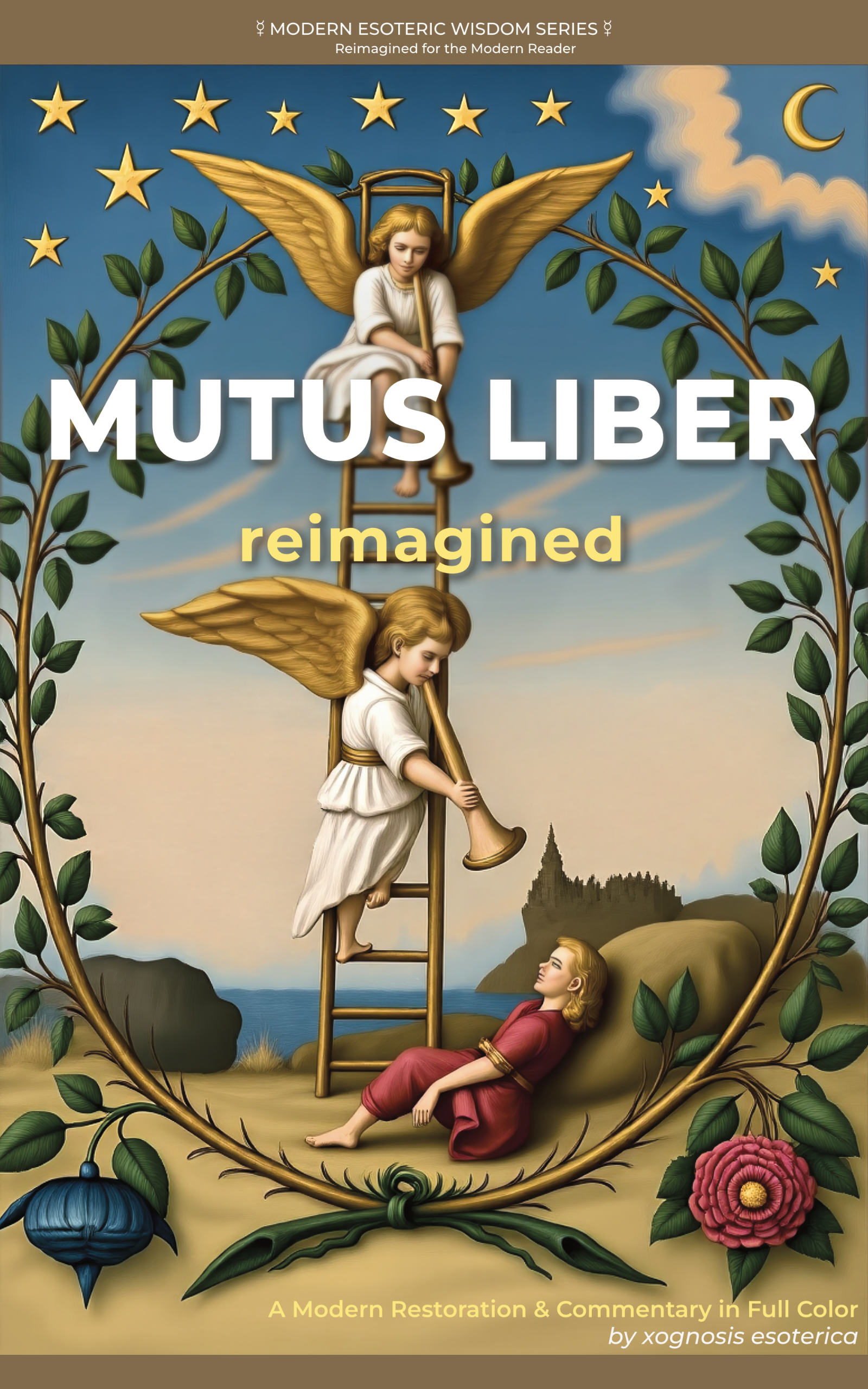
Twelve surviving copies is a fragile number for a book this load-bearing in the hermetic imagination. A 2015 limited intaglio edition from Editions à l'Envers, printed from the 1677 engravings, and Patrick Sembel's study "Hermès Atlantique, Le Mutus Liber, 1677," published the same year, both testify to continuing appetite for the silent book. For readers who want to sit with the fifteen plates themselves and test the air-and-invisibility reading against their own eyes, our full-color edition presents the imagery in restored color, and there is a monochrome version for those who prefer the engravings as the seventeenth century would have met them, in unrelieved line: Mutus Liber Reimagined, full color and Mutus Liber Reimagined, monochrome.
Look at the plates slowly. That was always the intended method, and it remains the only one the book itself endorses.
Read the book
Related Articles
Continue through articles sharing this topic.
Some books resist being read aloud. You can summarize a novel over dinner, and a history book lends itself to bullet points, but a certain strain of…
7 min read
Two books sit at the far ends of the esoteric shelf, and they answer the same question in opposite ways.
6 min read
A book with no sentences is a bold wager. In 1677, at La Rochelle on the French Atlantic coast, the publisher Pierre Savouret printed a slim volume of…
6 min read
The Mutus Liber arrived in 1677 as a book with almost no words in it. Fifteen engraved plates, published in La Rochelle by Pierre Savouret, credited to an…
5 min read
Related Books
Catalog volumes sharing this article’s lead tag.