 Xognosis EsotericaArcane Publishing Studio
In texts the church never canonized, the same argument keeps breaking out. A woman speaks. A man objects that she is speaking too much, or should not speak at all. A third voice, usually the risen Savior's, settles the matter. The scene recurs in the Pistis Sophia, the Gospel of Mary, the Gospel of Thomas, and the Gospel of Philip.
Share
In texts the church never canonized, the same argument keeps breaking out. A woman speaks. A man objects that she is speaking too much, or should not speak at all. A third voice, usually the risen Savior's, settles the matter. The scene recurs in the Pistis Sophia, the Gospel of Mary, the Gospel of Thomas, and the Gospel of Philip. Centuries later, alchemical images quietly assume the point: the work at the bench proceeds through a woman's hands. Three traditions that disagree about nearly everything keep arriving at the same tableau. A woman understands more than the men around her, and the men find it unbearable.
The Pistis Sophia survives in a single Coptic manuscript, the Askew Codex, now British Library Add. 5114, purchased by the British Museum in 1785. Modern scholarship places its composition in the second or third century; Sarah Parkhouse argues in a 2022 study that the first three books reflect a late third-century Egyptian community working out what counted as scripture. It is a compilation, much of it questions put to the risen Jesus about the fall and rescue of a divine figure named Pistis Sophia.
Most of those questions come from Mary. The text says only "Mary," and the e-Clavis scholarly entry notes that both Mary the mother and Mary Magdalene appear while most questions come from an ambiguous "Mary." The Magdalene identification belongs to scholarship, not to the text's own claim. Whoever she is, Jesus praises her extravagantly. In G. R. S. Mead's translation of chapter 17: "Mary, thou blessed one, whom I will perfect in all mysteries of those of the height, discourse in openness, thou, whose heart is raised to the kingdom of heaven more than all thy brethren."
Peter has had enough by chapter 36. "My Lord, we will not endure this woman, for she taketh the opportunity from us and hath let none of us speak, but she discourseth many times." Jesus rules against him: "Let him in whom the power of his spirit shall seethe, so that he understandeth what I say, come forward and speak." Violet MacDermot's modern translation uses "Mariam," and where Mead has Mary fear that Peter "hateth our sex," MacDermot gives "our race"; even the pronouns of this fight are translator's choices. The fear surfaces in chapter 72. Mary says her mind is always ready with the answer, "but I am afraid of Peter, because he threatened me and hateth our sex." Jesus answers that whoever is filled with the spirit of light may come forward and speak, and "no one shall be able to prevent him." The fear is textual fact. What it reflects about the community that wrote it is interpretation.
The Gospel of Mary is shorter, older by some estimates, and bruised. Composed between 120 and 180 CE on current estimates, it survives in a Coptic manuscript probably copied around 400, bought in Cairo in 1896, missing its first six pages and pages 11 to 14, with two third-century Greek fragments confirming parts of it. It names its heroine only as Mary; the Magdalene reading is scholarly consensus drawn from internal echoes, not a statement the text makes.
Peter asks Mary to share the private teaching the Savior gave her: "Sister we know that the Savior loved you more than the rest of woman. Tell us the words of the Savior which you remember which you know, but we do not, nor have we heard them." She does, at length, and the reception is ugly. Andrew declares he does not believe the Savior said any of it. Peter asks whether the Savior would really "speak privately with a woman and not openly to us," and whether they must now "all listen to her." Mary weeps and asks whether Peter thinks she is lying. Levi answers: "Peter you have always been hot tempered. Now I see you contending against the woman like the adversaries. But if the Savior made her worthy, who are you indeed to reject her? Surely the Savior knows her very well."
One popular error needs correcting here. The famous line about the Savior kissing Mary on the mouth comes from the Gospel of Philip, a different text with a lacuna in that sentence. The Gospel of Mary contains no such scene. It offers instead a portrait of a community where a woman's authority is asserted, resented, and defended. Xognosis publishes The Gospel of Mary in a clear English edition built on Mark M. Mattison's public-domain translation, with a reader's guide.
The pattern extends further. Gospel of Thomas 114 has Peter demanding that "Mary leave us, for females don't deserve life," with Jesus replying that he will "make her male," a saying scholars regard as a later addition. Gospel of Philip reports the disciples asking why the Savior loves Mary more than all of them. Four independent texts, one argument.
Then the tradition changed sides. The New Testament presents Mary Magdalene as a woman healed of seven demons, a witness at the crucifixion and burial, and a witness of the resurrection. It never calls her a prostitute and never identifies her with Luke's unnamed sinful woman. That fusion is Gregory the Great's interpretive act, in a homily delivered probably in 591: "We believe that this woman is Luke's female sinner, the woman John calls Mary, and that Mary from whom Mark says seven demons were cast out." Gregory read the demons as "all the vices," and the composite penitent governed Western art for over a millennium. It is legend by classification, however authoritative its source, and it has a birthday.
Alchemy's version is older than all of it and names no one. Maria the Jewess, active between the first and early third century, is generally regarded by historians as the first actual alchemist who is not a mythical figure. Everything about her reaches us through quotation in later authors, chiefly Zosimos of Panopolis, who called her "the divine Maria" and credited her with the tribikos, the kerotakis, and the warm-water bath still called a bain-marie. Tradition credits her with the instruction "Join the male and the female, and you will find what is sought," and with the Axiom of Maria: "One becomes two, two becomes three, and by means of the third and fourth achieves unity. Thus two are but one." Medieval readers conflated her with Miriam the sister of Moses and with Mary Magdalene, a documented confusion that shows the name's pull.
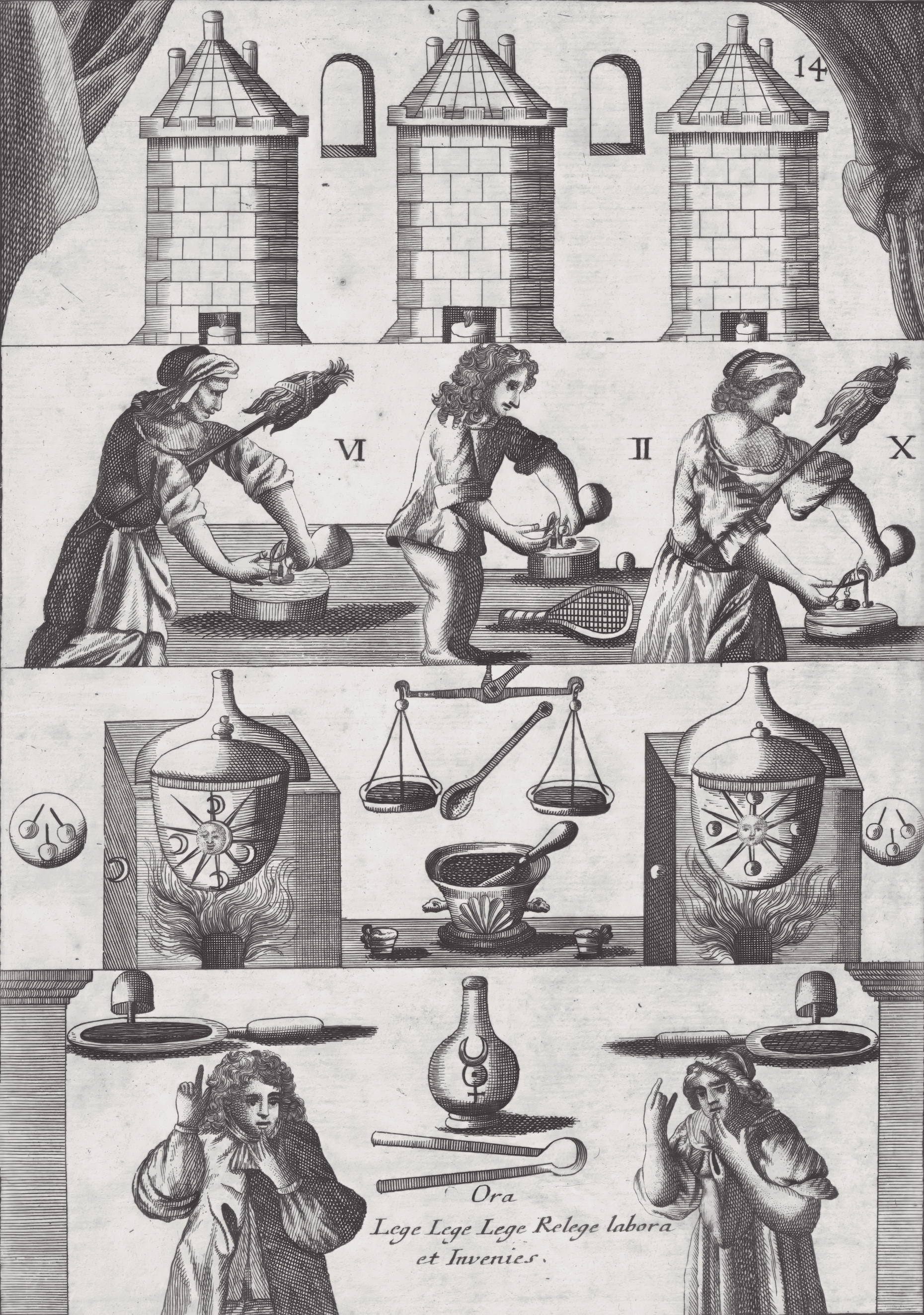
Roughly fifteen centuries after Maria, the Mutus Liber made the pairing literal. Published at La Rochelle in 1677 and signed "Altus," it is a silent book of fifteen engraved plates carrying the motto "Ora, Lege, Lege, Lege, Relege labora, et Invenies" on its first plate: pray, read, read, read, reread, labor, and you will find. Current scholarship names Isaac Baulot, a La Rochelle apothecary born in 1612, as the author; the older Jacob Saulat attribution is cataloged as doubtful legend.
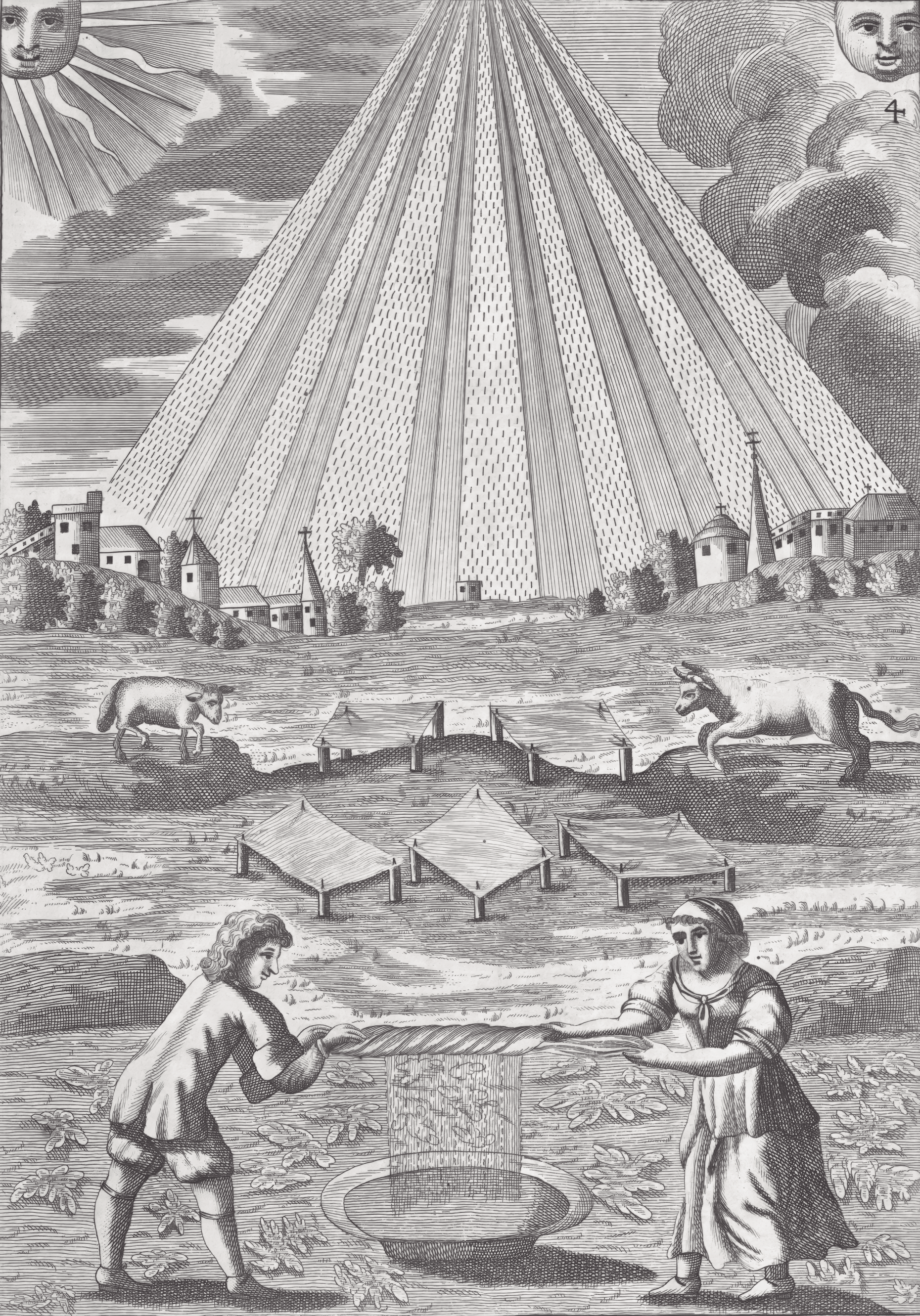
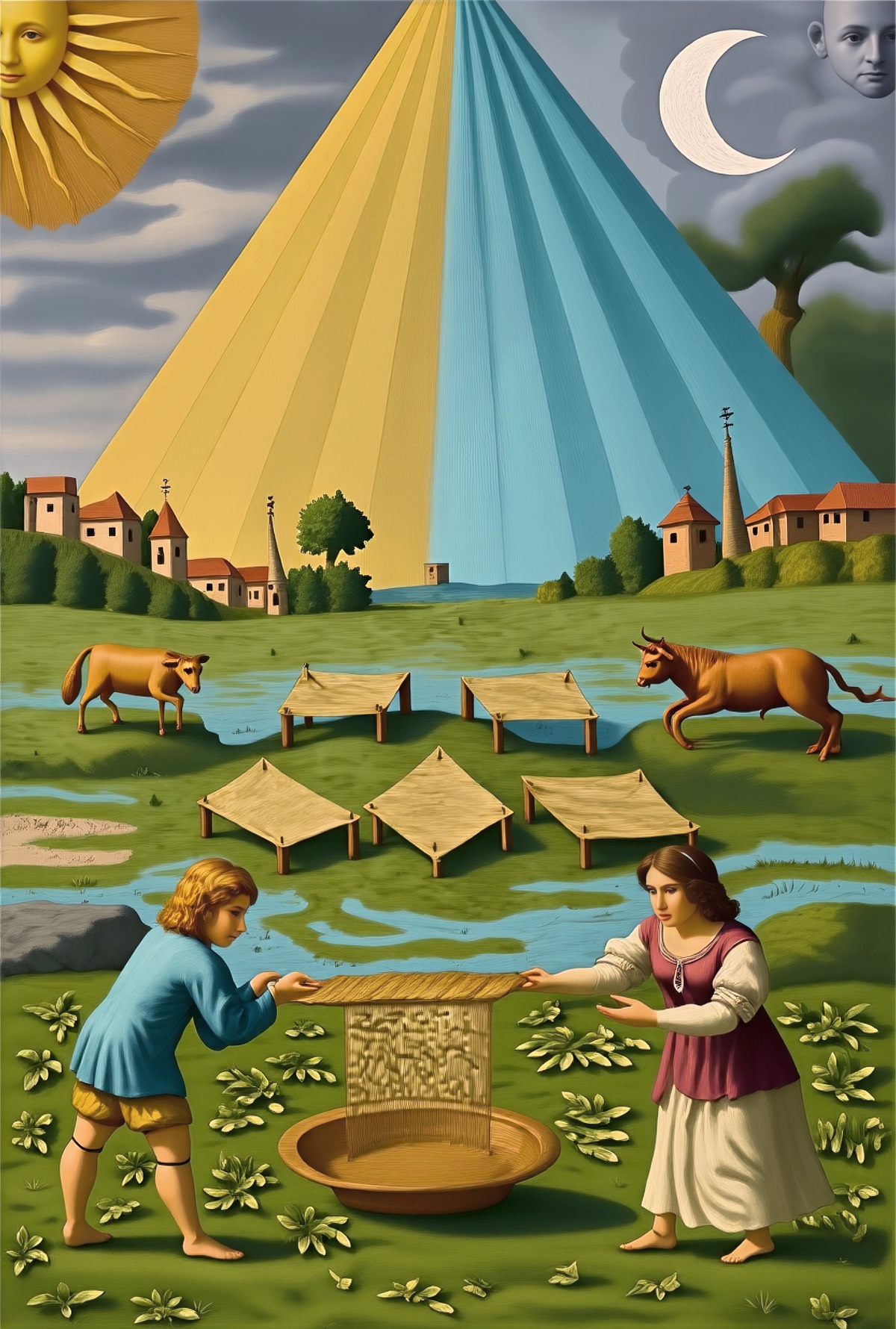
The plates show a man and a woman working side by side at every stage: kneeling before the athanor, wringing sheets charged with heavenly dew, tending the pot over the fire. The book names no one and says nothing. When the early twentieth-century commentator Pierre Dujols described the woman skimming the work and loading the matrass, he wrote that "it is in fact the feminine element which performs the selection by means of its constitutive virtues." That is Dujols interpreting, two centuries on; the plates show the operations as unthinkable without her. Plate 14 shows a woman with a distaff, and Dujols's advice is to "follow her with sagacity in his manipulations."
Xognosis's Mutus Liber Reimagined presents all fifteen engravings in color with commentary, and Pistis Sophia Reimagined offers the gnostic text with full context.
Put the traditions side by side and the disagreement is the interesting part. The gnostic texts make the woman's knowledge revelation and rank it above male grievance. Gregory's homily dissolves the knowledgeable woman into a penitent. The alchemical images skip the argument and put her hands on the apparatus.
Across a thousand years and three hostile traditions, the same scene recurs: a woman who understands, men who object, and a verdict imposed from outside. The texts preserve the argument because they could not settle it. The images end it by showing the woman already at work.
Read the book
Related Articles
Continue through articles sharing this topic.
Esoteric literature has a way of swallowing beginners whole. You pick up one book about alchemy, and within a week you have six tabs open about Renaissance…
7 min read
In January 1896 the German scholar Carl Reinhardt bought a Coptic papyrus codex in Cairo.
7 min read
Every few decades, someone translates the esoteric classics again. New Enoches appear. New Pistis Sophias.
6 min read
Pick a shelf of spiritual books at random and you will find, somewhere in the first twenty pages, the same accusation: you are not actually awake.
7 min read
Related Books
Catalog volumes sharing this article’s lead tag.