 Xognosis EsotericaArcane Publishing Studio
In thirteen days of January 1564, John Dee wrote one of the strangest books in the history of science. He began on the 13th of the month, he tells us himself, and ended "his labours peacefully on the 25th day of January which he had begun on the 13th day of that month." The result, the Monas Hieroglyphica, printed at Antwerp by Willem…
Share
In thirteen days of January 1564, John Dee wrote one of the strangest books in the history of science. He began on the 13th of the month, he tells us himself, and ended "his labours peacefully on the 25th day of January which he had begun on the 13th day of that month." The result, the Monas Hieroglyphica, printed at Antwerp by Willem Silvius and dedicated to Maximilian II, is a short treatise in twenty-four theorems devoted to a single invented symbol: a compact little diagram of circles, crescents, and crossed lines that Dee claimed contained, in one figure, the working principles of astronomy, alchemy, and more. He announced his method on the title page itself. The work, he said, would be explained "Mathematicè, Magicè, Cabalisticè, Anagogicèque": mathematically, magically, cabalistically, anagogically. Four registers at once, for a glyph the size of a thumbnail.
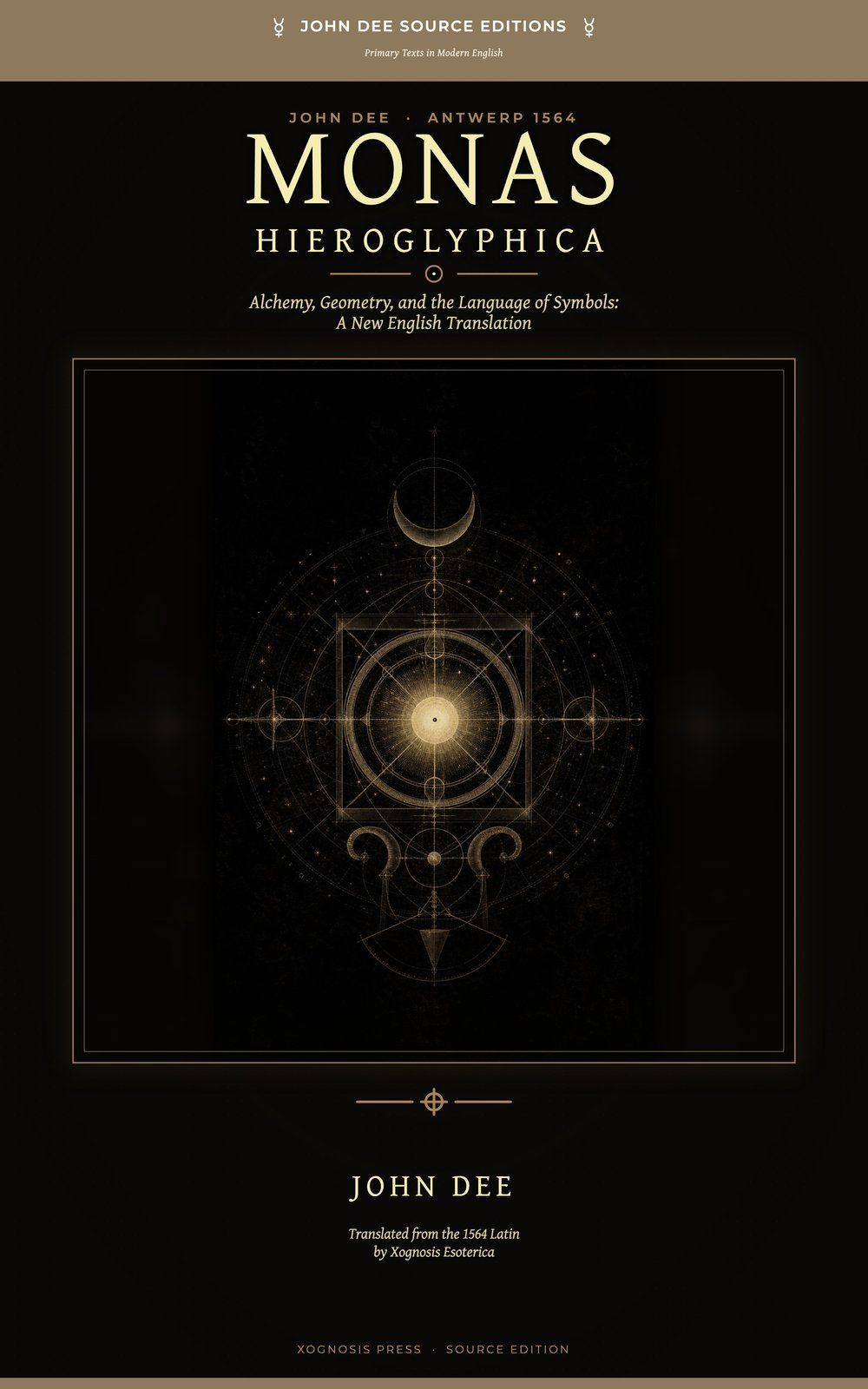
The symbol matters here for a specific reason. Dee built his Monad out of the astronomical signs of the planets, and in the alchemical tradition those same signs named the metals. The Monad is therefore a diagram that runs on a doubling, and the later theorems of Dee's book are where that doubling does its work.
The correspondence was old long before Dee touched it. Sun and gold, Moon and silver, Mercury and quicksilver, Venus and copper, Mars and iron, Jupiter and tin, Saturn and lead: these pairings were the shared property of premodern astronomy, astrology, and alchemy, a single sign-set serving three disciplines. Peter Forshaw, whose 2017 study of the Monas frontispiece is the sharpest recent reading of the book, puts it in one sentence: the Monad is composed of "the symbols that represent the seven planets of the Ptolemaic cosmos in astronomy and astrology and the seven metals of transmutational alchemy."
One qualification is worth stating plainly, because careless accounts blur it. Nowhere does the Monas print a tidy table pairing each planet with its metal. The doubling works indirectly, through the shared signs, through the title page's insistent language about Mercury, and through a run of later theorems about what Dee calls the inferior astronomy. Readers who want Dee's own text, theorem by theorem, can find it in our edition of the Monas Hieroglyphica.
Dee was not a dilettante at this material. The documentary record shows a working alchemist. He acquired his first alchemical text in 1551. In July 1556 he drew up a list of fifty-five "alchemical authors I read during July," preserved in Corpus Christi College, Oxford (MS 191). Jennifer Rampling's research establishes that he kept a laboratory at Mortlake, with real apparatus and real materials. He was, in short, fluent in the metal-workers' half of his own symbol system.
He may also have had a visual model. Forshaw points to Petrus Bonus's Pretiosa margarita novella of 1546, with its diagrams of the "trees of the seven metals," as a work Dee read that mapped the planet-metal system in pictures. Whether Dee took the idea of a metal-diagram directly from Bonus is interpretation; that he moved in a culture which diagrammed these correspondences is fact.
The early theorems take the Monad apart like a watchmaker. The circle is the Sun and the crescent beneath it the Moon; the whole upper figure, Dee explains, is the astronomer's own sign for the planet Mercury, resting on the open horns of the zodiacal Ram. Then, around Theorem X, the alchemical machinery engages. "We have added the astronomical sign of Aries, therefore," Dee writes, "to signify that (in the practice of this monad) the aid of fire is required." A zodiacal sign becomes a furnace instruction. The astronomer's Aries, first sign of spring, is read by the alchemist as the fire the work cannot do without.
Theorem XIV pushes further into explicitly alchemical territory, and Dee reaches for the most famous authority in the tradition, the Emerald Tablet attributed to Hermes Trismegistus. The Sun, he says, is "its father and the Moon its mother," with the work "nourished in Lemnian earth by lunar and solar rays." The parental language is Hermetic on purpose: Dee is grafting his diagram onto a text alchemists treated as foundational.
In the later theorems, the ones this article is chiefly about, the planet-metal doubling becomes the engine of the argument. Dee introduces his "inferior astronomy," and in Theorem Eighteen he states the relationship without ceremony: "celestial astronomy is like a parent and teacher to Astronomia inferior, i.e. alchemy." The metals in the earth answer to the bodies in the sky, and both speak one sign language. The title page had already told the reader where this leads. Its central motto, "Est in hac Monade quicquid quaerunt sapientes," is an open paraphrase of the old alchemical aphorism "Est in Mercurio quicquid quaerunt sapientes": in Mercury is whatever the wise seek, so in this Monad is whatever the wise seek. The glyph is offered as a stand-in for the one metal that rules the rest, and the ribbon wound around it drives the point home: "Mercury becomes the parent and king of all the planets when made perfect by a stable pointed hook," in Forshaw's translation. To an astronomer of the day that claim sounded outrageous. To an alchemist, reading Mercury as quicksilver, the parent stuff of every metal, it made obvious sense.
How far the later theorems literally walk through the seven metals deserves care. The Monas never enumerates the pairs, and Theorems XVII through XX are dense enough that anyone quoting them verbatim should check C. H. Josten's 1964 translation in Ambix, the standard one. But the direction of travel is certain: as the theorems proceed, the planets behave less like objects in the sky and more like reagents in a vessel.
Dee's contemporaries and successors read the Monas largely as an alchemical book, whatever else Dee intended by his fourfold method. Forshaw has traced that reception across Latin, French, and German alchemical literature in a 2005 study, and Andrew Campbell has documented the Italian side, where printed references appear within decades of publication. In England, a dedication of 1591 praised "M. Doctor Dee in his Monas Hyerogliphica." The praise comes from Ralph Rabbards's dedication to his 1591 edition of Ripley's Compound of Alchymy, which is no doubt why it is so often credited to Ripley's own book; the quotation is preserved through Jennifer Rampling's work on English alchemy in the Holy Roman Empire.
The afterlife grew more fantastic. By 1616 the monad appears on the wedding invitation printed in the Rosicrucian Chymische Hochzeit at Strasbourg, a documented appearance rather than a rumor. Later it was reproduced in full in Lazarus Zetzner's Theatrum Chemicum, the great Strasbourg collection of alchemical literature, praised in Elias Ashmole's Theatrum Chemicum Britannicum of 1652, and even used as a personal mark by John Winthrop the Younger, governor of Connecticut. The bolder legend, Dee as the secret inspirer of Rosicrucianism itself, belongs to a modern scholarly tradition that remains contested; it should be held loosely.
There was also a hostile legend, and it stung. Foxe's Book of Martyrs, of all books, referred to him as "Doctour Dee the great conjurer." The gibe angered him, and Forshaw suggests the sting may even have been one reason Dee took the Monas itself to a printer in Antwerp. The historical Dee, so far as the documents run, was a mathematician and a laboratory man who believed his little diagram held a real key.
Dee's Monad compresses an entire shared language into one glyph: the signs of the seven planets are, at a stroke, the signs of the seven metals, so that reading the heavens and reading the furnace become the same act of reading. The later theorems do not list the seven pairs in a table; they assume you already speak the language, and then they teach you to speak it downward, from sky to crucible.
Read the book
Related Articles
Continue through articles sharing this topic.
Esoteric literature has a way of swallowing beginners whole. You pick up one book about alchemy, and within a week you have six tabs open about Renaissance…
7 min read
Somewhere around the year 1310, a Latin author sat down to write a book about furnaces.
6 min read
Sometime around the end of the thirteenth century, a writer working in Latin composed a long, disciplined treatise on the art of alchemy.
6 min read
There is a story about alchemy that almost everyone knows. For centuries, so it goes, clever men wasted their lives stirring molten metals and muttering…
6 min read
Related Books
Catalog volumes sharing this article’s lead tag.
Mutus Liber Reimagined (The Silent Book): A Modern Restoration & Commentary in Full Color Discover the Hidden Wisdom of Alchemy's Most Enigmatic Masterpiece, Now in Stunning Full…
Xognosis Esoterica
Mutus Liber Reimagined (The Silent Book): A Modern Restoration & Commentary in Monochrome Discover the Hidden Wisdom of Alchemy's Most Enigmatic Masterpiece, Now in Striking Monoc…
Xognosis Esoterica
Rendered Faithfully for the Modern Seeker Summa Perfectionis, or "The Sum of Perfection," is widely regarded as the most influential alchemical treatise of the Latin Middle Ages.…
Xognosis Esoterica