 Xognosis EsotericaArcane Publishing Studio
In February 1570, a printer named John Day pushed through his presses an enormous English translation of Euclid, and pinned to the front of it a long essay by John Dee on what mathematics was actually for.
Share
In February 1570, a printer named John Day pushed through his presses an enormous English translation of Euclid, and pinned to the front of it a long essay by John Dee on what mathematics was actually for. Near the end of that essay, after pages of taxonomy and exhortation, Dee arrives at the last item on his list of the mathematical sciences and admits, in effect, that he has saved the strangest for last. He calls it Archemastrie. He declares it the sovereign of all the arts he has just catalogued. And then the word more or less vanishes from the history of science, which is a curious fate for something its inventor ranked above astronomy, navigation, and architecture combined.
The essay is the Mathematicall Praeface, appended to Henry Billingsley's Euclid and printed by Day on February 25, 1570. Dee's purpose was recruitment. He wrote for readers he imagined "almost out of courage, and in despayre," convinced that Geometry "had but serued for buildyng of an house, or a curious bridge, or the roufe of Westminster hall." So he built a map. The Praeface lays out a grand classification in which Geometry, the mother science, generates a family of derivative arts, each a practical trade grounded in mathematical principle.
The full roll call runs to nineteen names, and even the middle of the list reads like a cabinet of curiosities: "As Perspectiue, Astronomie, Musike, Cosmographie, Astrologie, Statike, Anthropographie, Trochilike, Helicosophie, Pneumatithmie, Menadrie, Hypogeiodie, Hydragogie, Horometrie, Zographie, Architecture, Nauigation, Thaumaturgike and Archemastrie." Some of these are familiar; Trochilike (the mathematics of wheel motion) and Helicosophie (the screw) are not. The whole scheme was printed as the Groundplat, a chart rather than running prose, laid out in the original as a stemma, a tree, on an oversized foldout leaf.
Navigation and Thaumaturgike, the art of "straunge workes, of the sense to be perceiued," sit near the end. But the terminal branch, the one beneath which nothing else grows, is Archemastrie. Dee placed it last, and he meant it.
His definition comes in the closing section of the Praeface, and it is worth hearing at length, in his own words. Archemastrie, he writes, "teacheth to bryng to actuall experience sensible, all worthy conclusions by all the Artes Mathematicall purposed, & by true Naturall Philosophie concluded: & both addeth to them a farder scope, in the termes of the same Artes, & also by hys propre Method, and in peculier termes, procedeth, with helpe of the foresayd Artes, to the performance of complet Experiences, which of no particular Art, are hable (Formally) to be challenged."
In plain terms, the instinct is recognizably modern. Every specialized mathematical art produces conclusions, but each is confined to its own terms. Archemastrie is the discipline that takes conclusions from anywhere in the tree and forces them into "actuall experience sensible," into tests a human being can witness. It has, Dee says, its own method and its own vocabulary. It exists precisely because no single art can formally claim the experiences it produces.
He then does something odd for a taxonomy: he promotes his own category above the taxonomy. "Science I may call it, rather, then an Arte: for the excellency and Mastershyp it hath, ouer so many, and so mighty Artes and Sciences." The name itself, he insists, "is not so new, as this Arte is rare," remarking that another art, a degree beneath this one in skill and power, had carried the English name before. Quite what he meant by that is genuinely obscure, and scholars have read it in more than one way. His claim that the name is old does not establish that the word circulated before 1570 in anything like this sense, and it is safest to leave the remark as a puzzle Dee created rather than one anyone has solved.
Dee did not pretend he had invented experimental science out of nothing. He reports that "it is named of some, Scientia Experimentalis. The Experimentall Science," and he names a source: "Nicolaus Cusanus termeth it so, in hys Experimentes Statikall."
Then comes a more delicate allusion. "And an other Philosopher, of this land Natiue (the floure of whose worthy fame, can neuer dye nor wither) did write therof largely, at the request of Clement the sixt." The unnamed English philosopher is widely read as Roger Bacon, who did write on experimental science at papal request, and the Gutenberg transcription records a marginal note, "R. B.", at exactly that line. But the Praeface leaves him unnamed, and there is a wrinkle: Bacon's major papally commissioned writings are usually tied to Clement IV, not Clement VI. Either Dee misremembered the pope's number, or he means something slightly different by the reference. Presenting Bacon as the intended figure is an interpretation, a well-supported one, and the papal-number tension is real enough that any honest account has to carry it.
Here the record thins, and honesty requires saying so. What can be stated as fact is narrow: the word "Archemastrie" appears in the 1570 Praeface, defined and enthroned as we have seen, and it did not become the name of an ongoing discipline with practitioners working under its banner. Dee's programme of a supreme experimental science, coordinating all the mathematical arts toward complete experiences, found no school and no succession of textbooks. The editorial claim in the title, that nobody else practiced it, is a judgment about that non-reception. No census of every later appearance of the word has been verified here, and the term's afterlife in dictionaries and footnotes belongs to a story the sources gathered for this essay cannot tell.
There is an irony worth sitting with. Within roughly a century of Dee's Preface, experimental philosophy did conquer the learned world, under other names, with other charters. The programme succeeded. The word died. Dee had positioned Archemastrie as the master science of exactly the thing the coming age would build, and he coined a name for it that the builders declined to use.
The context of the Praeface sharpens the loss. Its closing pages are a defense against slander: people who forged "monstrous feates, and wonderfull workes" in his name, and who, he says, "deuilishly" fathered "new fond Monsters" on him. He ends with a protestation of being "Innocent, in hand and hart," and that innocence is his own claim, made amid a real controversy, not a finding of history. Part of the Praeface's energy is defensive: an argument that mathematics, practiced through all its derivative arts up to the experimental summit, is godly, useful work. Archemastrie was the crown of that defense.
Dee invented the name Archemastrie for the supreme experimental science, gave it the bottom branch of his Groundplat and mastery over every art above it, and the word itself never caught on, even as the thing it described reshaped the following century under other names.
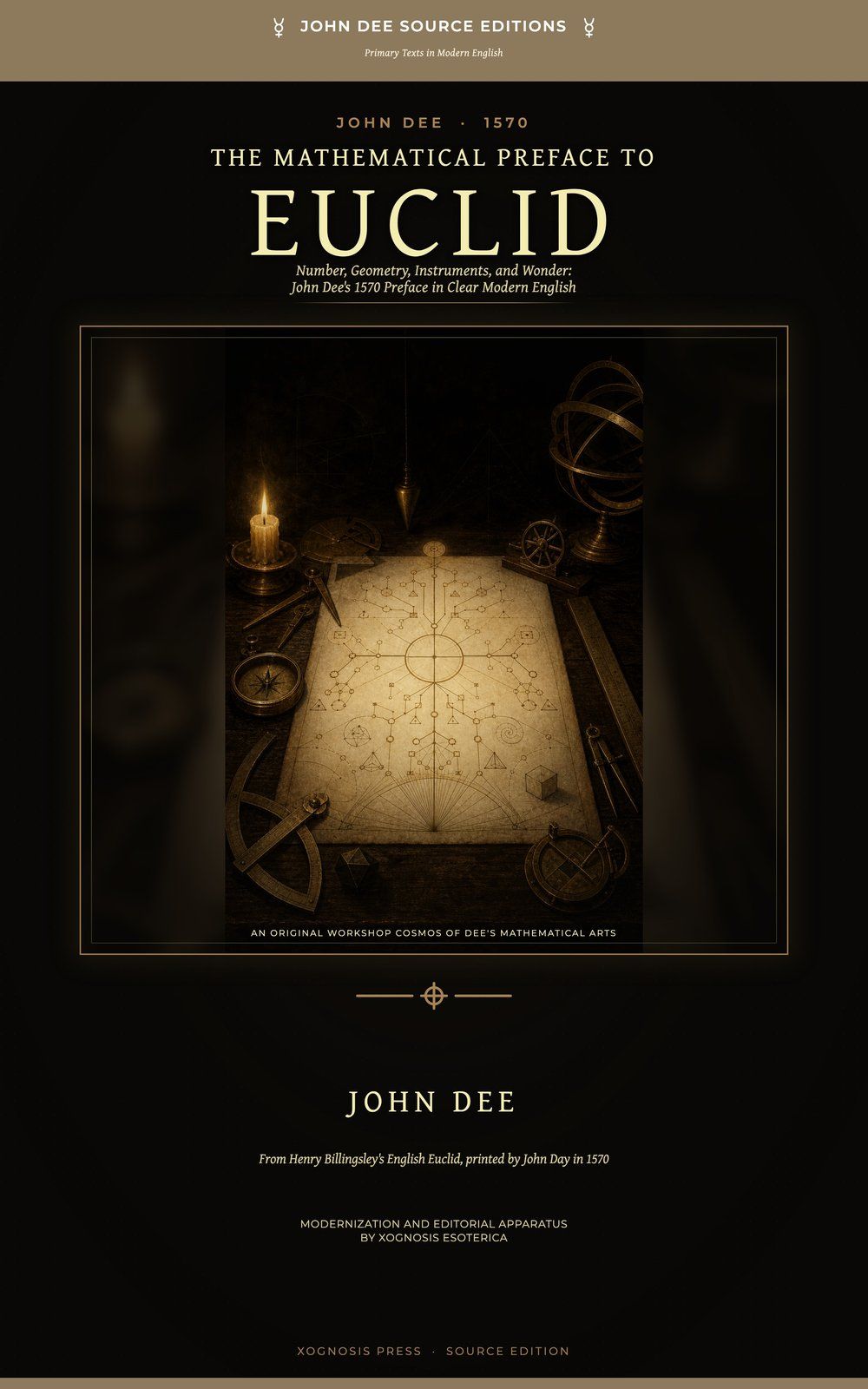
Readers who want to trace Dee's full tree, from Perspectiue down through Thaumaturgike to the terminal branch, can do so in The Mathematical Preface to Euclid, a modern-English edition that reconstructs the Groundplat both visually and as a searchable hierarchy of its seventy-two nodes.
Read the book
Related Articles
Continue through articles sharing this topic.
Two books sit at the far ends of the esoteric shelf, and they answer the same question in opposite ways.
6 min read
In the summer of 1552, two of the most restless minds in Europe were, as far as anyone can tell, in the same city at the same time.
6 min read
Open a modern edition of A True and Faithful Relation and you meet a problem before you meet a single angel.
7 min read
Open a page of John Dee's Monas Hieroglyphica at random and you see a strange object: a single compound sign, part astronomical, part alchemical, drawn once…
6 min read