 Xognosis EsotericaArcane Publishing Studio
In the spring of 1576, a forty-eight-year-old mathematician named John Dee spent his days on board a cluster of ships tied up on the Thames, teaching sailors their trade. Not sword drill or sail handling. Geometry, astronomy, and the use of instruments.
Share
In the spring of 1576, a forty-eight-year-old mathematician named John Dee spent his days on board a cluster of ships tied up on the Thames, teaching sailors their trade. Not sword drill or sail handling. Geometry, astronomy, and the use of instruments. Within weeks those ships would sail west under Martin Frobisher, hunting a passage to Cathay through the ice of the Arctic. The men who steered them did so with a theory of navigation in their heads that Dee had spent years committing to print, and that theory had a specific home: the long introductory essay he wrote for the first English translation of Euclid, printed in London in 1570. Our own edition of that essay, The Mathematical Preface to Euclid, returns it to readers who want to see the program whole.
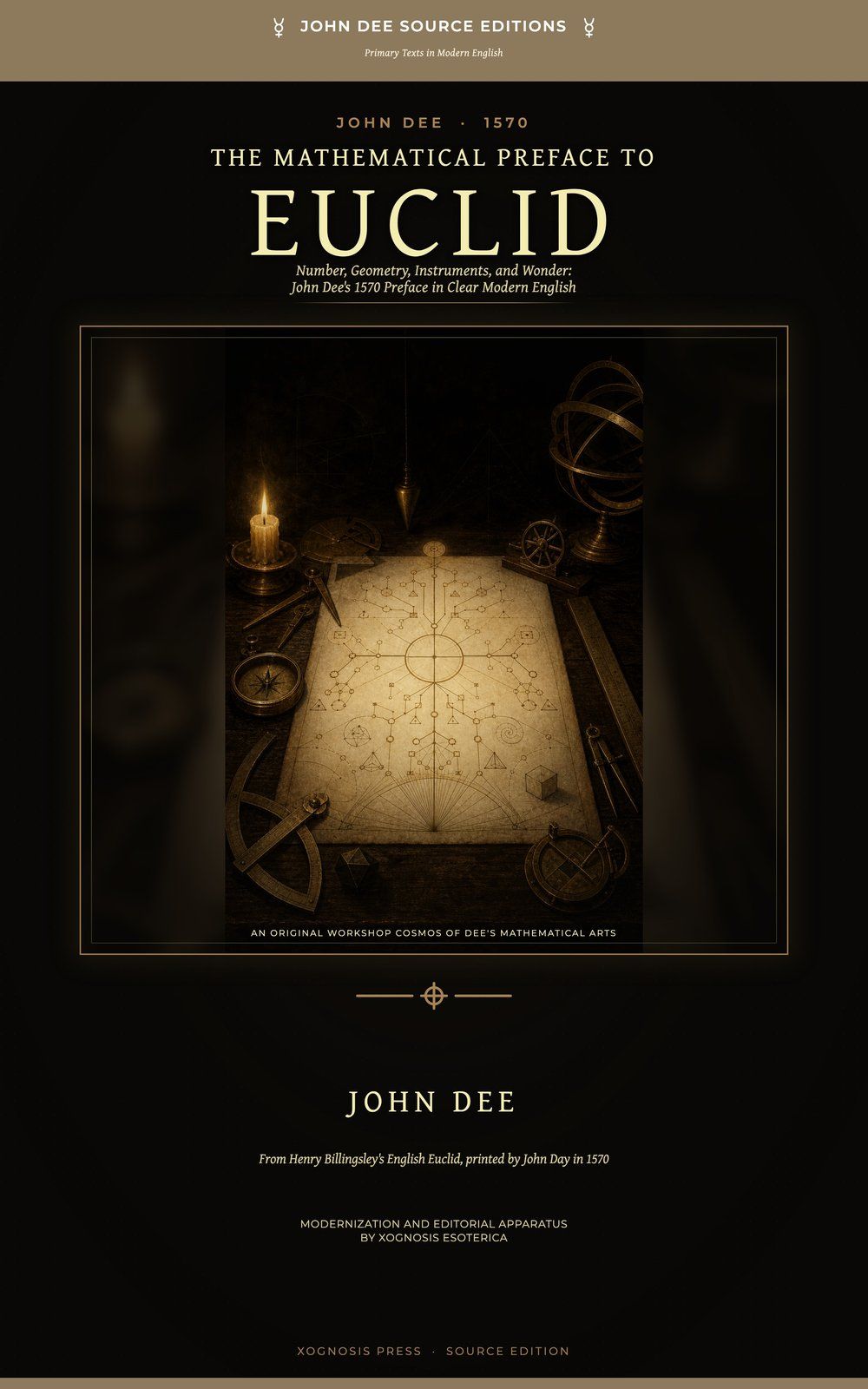
The book Dee chose to preface was itself a wager. Henry Billingsley, a merchant who would later become Lord Mayor of London, translated Euclid's Elements of Geometrie into English, and the printer John Day published it in 1570. Euclid in the vernacular meant that geometry no longer belonged exclusively to readers of Latin and Greek. Merchants, craftsmen, and shipmasters could, in principle, now learn it.
Dee's contribution, the "Mathematicall Praeface," ran far beyond the ordinary duties of a preface. Stephen Johnston, in a study of Dee and the Euclidean tradition, notes that Dee places great stress on the fundamental role of arithmetic and geometry across the whole of practical life. The Praeface is essentially a map of the mathematical arts: Dee sorts them into branches descending from Arithmetic and Geometry, and then shows, art by art, how each one serves human work. Navigation gets a full entry. So do the charting art he calls Hydrographie, astronomy, and Horometrie, the measurement of time.
When Dee reaches Navigation, he defines it with unusual care:
"The Arte of Nauigation, demonstrateth how, by the shortest good way, by the aptest Directiõ, & in the shortest time, a sufficient Ship, betwene any two places (in passage Nauigable,) assigned: may be cõducted: and in all stormes, & naturall disturbances chauncyng, how, to vse the best possible meanes, whereby to recouer the place first assigned."
Read it slowly and the definition turns out to be dense with commitments. Navigation is demonstrable, which is to say provable, in the geometric sense. It concerns the shortest route between two assigned places, which presupposes that you know where you are and where you are going, on a sphere, with math. And it includes recovery from storms, the art of getting back to your intended point after the sea has had its way with you. On this definition the navigator's craft is directed, calculated movement, from a known point toward a known point, on a schedule.
Dee then itemizes the supporting arts the master pilot needs: "Hydrographie, Astronomie, Astrologie, and Horometrie." Hydrographie, the making and reading of sea charts, exists for navigation in the first place, as Dee says elsewhere in the Praeface: "The chief vse and ende of this Art, is the Art of Nauigation." The chart serves the voyage. The stars serve the voyage. The measured hour serves the voyage.
The most striking sentence in the Praeface's treatment of navigation is a patriotic one: "Yet, this one thyng may I, (iustly) say. In Nauigation, none ought to haue greater care, to be skillfull, then our English Pylotes." Dee draws a straight line here between mathematical study and national standing. An island nation whose pilots cannot calculate is a nation dependent on foreign expertise and foreign charts. The Royal Museums Greenwich assistant curator Alex Grover, reassessing Dee's legacy, describes him as already teaching navigation to Muscovy Company traders and lecturing to students at his house in Mortlake from the mid-1560s, well before the Praeface was printed. The Praeface gave that running curriculum a public, printed form.
That is the honest way to frame the connection, and it matters, because a tempting legend has Dee standing at Frobisher's side as court magician, scrying the ice ahead. The documents support something more interesting. The Dictionary of Canadian Biography records that Dee "passed the spring of 1576 on board Frobisher's ships, instructing the men in the new art of cosmological and mathematical navigation." The phrase "new art" is doing real work: this was instruction in method, instruments, and the mathematical frame behind them, the same frame the Praeface had laid out in print six years earlier. Whether Dee ever quoted his own essay aloud on deck we do not know, and no source says so. What the record supports is that the Praeface's program and the quayside lessons came from the same mind, aimed at the same deficiency.
The instruction was put to the test quickly. Frobisher's first voyage ran from 7 June to 9 October 1576, seeking the Northwest Passage. The second, 31 May to August 1577, shifted toward the ore the expedition believed was gold-bearing. The third, 31 May to August 1578, was the largest of all: fifteen vessels sailed from Harwich under Frobisher that May. Dee supported the expeditions, in the Royal Museums Greenwich's phrasing, "financially and as a navigational adviser." He was not a passenger or a mascot. He was a backer with a technical stake in how the courses were steered.
The contemporary narrative record of those voyages survives in George Best's 1578 folio account, and the scholarly treatment of Dee's exact role is William Sherman's essay in the Meta Incognita volumes on Frobisher's Arctic expeditions. Neither is needed to make the central point, which rests on Dee's own text and the biographical record: the man who defined navigation as a demonstrable mathematical art also stood on the decks in 1576 and taught it to the men who would sail.
Here is the interpretive claim of this article, offered as interpretation and not as documented fact. The spring of 1576 is best understood as the Praeface theory put into practice at the waterline. Dee's essay argues that a pilot's skill is a stack of dependent arts, geometry under Hydrographie, Hydrographie under Navigation, astronomy and timekeeping alongside them. The classroom version of that argument was the 1570 folio, a weighty tome for readers with bookshelves. The quayside version was Dee himself, reducing the stack to what a mariner could carry: the instrument, the chart, the star sight, and the arithmetic to combine them.
The distinction between fact and reading matters with Dee more than with most figures, because his later reputation as a conjurer has a way of colonizing his earlier career. The verifiable Dee of 1576 was a mathematician drilling crews in cosmography. The angel conversations and occult fame belong to his later years, and the popular image of the wizard aboard an Arctic ship should be set aside when the subject is navigation. Frobisher, who died of a wound received at Crozon on 22 November 1594, and Dee, who outlived him by well over a decade, are usually remembered as soldier-sailor and mystic. In the spring of 1576 they were something plainer and rarer: a patron of mathematical instruction and the crews who had to use it.
Dee told English pilots that none ought to have greater care to be skillful. For one season, on a set of ships about to cross into unknown water, the care was arranged in advance, and it looked like a man with a book's worth of theory teaching it a deck at a time.
Read the book
Related Articles
Continue through articles sharing this topic.
Two books sit at the far ends of the esoteric shelf, and they answer the same question in opposite ways.
6 min read
In the summer of 1552, two of the most restless minds in Europe were, as far as anyone can tell, in the same city at the same time.
6 min read
Open a modern edition of A True and Faithful Relation and you meet a problem before you meet a single angel.
7 min read
Open a page of John Dee's Monas Hieroglyphica at random and you see a strange object: a single compound sign, part astronomical, part alchemical, drawn once…
6 min read