 Xognosis EsotericaArcane Publishing Studio
On 25 January 1564, in a printer's house in Antwerp, an English mathematician put down his pen and declared a short book finished. He had started it twelve days earlier. He told his royal dedicatee that the symbol at the heart of it had been "conceived in London, born in Antwerp," and that the writing itself took "a space of only twelve…
Share
On 25 January 1564, in a printer's house in Antwerp, an English mathematician put down his pen and declared a short book finished. He had started it twelve days earlier. He told his royal dedicatee that its central symbol had been "conceived in London, born in Antwerp," and that the writing itself took "a space of only twelve days," the swift delivery of a child carried for nearly seven years. Four centuries later, that sentence has hardened into legend: a man seized by a visionary trance, channeling an occult classic in a fortnight. The documented record, assembled most carefully by the historian C. H. Josten in 1964, tells a more interesting story.
The evidence for the timeline is printed on the pages of the first edition. At the close of Theorem XXIV, the final theorem, Dee states in his own words that he finished the work "on the 25th January, having commenced it on the 13th of the same month. In the year 1564 at Antwerp." The colophon gives the printing date: 31 March 1564, from the shop of Guilielmus Silvius, typographer royal. The dedication to Maximilian II supplies the framing claim. In Latin, Dee says the symbol was the offspring of "almost seven continuous years" of labor, then brought forth "duodena solum dierum spatio," in a space of only twelve days.
Everything in that paragraph is Dee's testimony, and it deserves to be taken seriously as exactly that: what Dee chose to say about his own book, in a dedication designed to impress an emperor. The date statements are precise and checkable. The twelve-days flourish belongs to a different category. It is a birth metaphor, a dedicatory device in the classical mode, aimed at a king.
Dee amplified it himself. In Theorem XXIII he invokes "the Spirit swiftly writing these things through me," adding that he was, as he hoped and believed, "merely my pen." That is a devotional topos of inspired authorship, a genre convention as old as the poets. Read as a claim about Dee's clinical state of mind, it says almost nothing. Read as rhetoric, it says a great deal about how he wanted the book received.
If the writing was quick, the preparation was not, and the preparation is documented. On 16 February 1563, nearly a year before the writing dates, Dee wrote to William Cecil from Antwerp, giving his address as the house of Willem Silvius, at the sign of the Golden Angel in the Camer Straet. He had already settled in with the man who would print the Monas. In April 1563 he was in Zürich, signing the album amicorum of the naturalist Conrad Gesner. By September he was at Pressburg in Hungary, where his dedication says he spent "some delay" the previous September, and where Maximilian II was crowned King of Hungary on 8 September 1563. Stephen Clucas, following Josten, notes Dee was an "eye witness" to the coronation period, which goes some way toward explaining why a book about a single composite glyph was addressed to that particular Habsburg.
Dee's letter to Cecil also mentions Trithemius's Steganographia, which he called a book so fitting for a prince that "none can be meeter," and an unnamed Hungarian noble to whose courtesy he stood bound. This is the picture of a scholar on a sustained Continental research trip, collecting texts and patrons, not a man ambushed by revelation.
The physical book argues the same case. The main text runs to about 33 pages in the original edition, dense with diagrams that had to be cut, set, and corrected. Dee did not post the manuscript off and leave. He wrote it and saw it through the press while living in Silvius's house near the Camerpoort bridge, as Clucas puts it, and he told the printer as much. His letter to Silvius, dated 30 January 1564, calls the printer the "typographical parent" of the newborn work, able to "bring it forth and produce it trim and well put together in every way." The text took twelve days. The printing took another two months, with the author hovering over the formes.
The twelve days are Dee's own claim, printed in his own book. What they measure is the writing down of a short, intensely prepared text, not the incubation of its ideas, and not a trance.
The myths began later, and each can be dated.
The trance story is the biggest distortion. Modern retellings, such as the otherwise useful introduction to the Hamilton-Jones translation online, say Dee "wrote it in twelve days while apparently in a peak (mystical) state." The only documented dictation-like episodes in Dee's life are the angel conversations, and those begin on 22 December 1581, seventeen years after the Monas appeared. Reading the later Dee back into the 1564 author is an anachronism, however tempting the fit seems.
The presentation legend says Dee traveled to hand the finished book to Maximilian in person. Here the record is genuinely thin, and honest accounts should say so. The Compendious Rehearsal, Dee's 1592 autobiographical account, notes only his return "from the Emperor's court" by 14 June 1564. Josten doubted Dee had time to make the journey; Glyn Parry has reconstructed a plausible itinerary; Clucas reports the doubt fairly. Treat the audience with Maximilian as unresolved. The parallel story is on firmer ground: in 1584 Dee presented a copy to Emperor Rudolf II through the Spanish ambassador, and was received.
The secrecy industry grew from older soil. Speculation that the Monas is a cipher book for spies descends from a reading of Dee's life that Barone traces back toward Hooke and later popularizers. A modern library blog records, carefully attributing them to unnamed believers, the ideas that the book accompanied lost oral lessons or served as a cryptography manual. None of these has documentary support. What the record does show is readers struggling. Brian Vickers called it "possibly the most obscure work ever written by an Englishman," and Allen Debus found it "largely unintelligible" even to its twentieth-century commentators. Obscurity invited invention.
Not every afterlife story is legend. In Nicholas Clulee's judgment, no other work of Dee's had a stronger publication history: a Frankfurt reprint in 1591, inclusion in the great Theatrum chemicum of 1622 and 1659, named readers and critics across a century, and a genuine thread into Rosicrucian print culture through the Consideratio brevis of 1615. Influence is fact. Rosicrucian membership is not; there is no evidence Dee belonged to the society.
Even the number drifts. Counting 13 and 25 January inclusive gives thirteen calendar days, which is why some retellings say thirteen. Dee said twelve, and the title of this article follows the primary source.
One documented scene deserves the last word. By 14 June 1564, back in England, Dee recorded that Elizabeth I "very graciously vouchsafed to account herselfe my schollar in my booke." She had read his title-page motto, "Qui non intelligit, aut taceat, aut discat" (let him who does not understand either keep silent or learn), and answered that if he would disclose its secrets, "she would et discere et facere," both learn and do. He also recorded her defending the book against university graduates "who therefore dispraised it, because they understood it not." The queen, at least, took the honest option the motto offered.
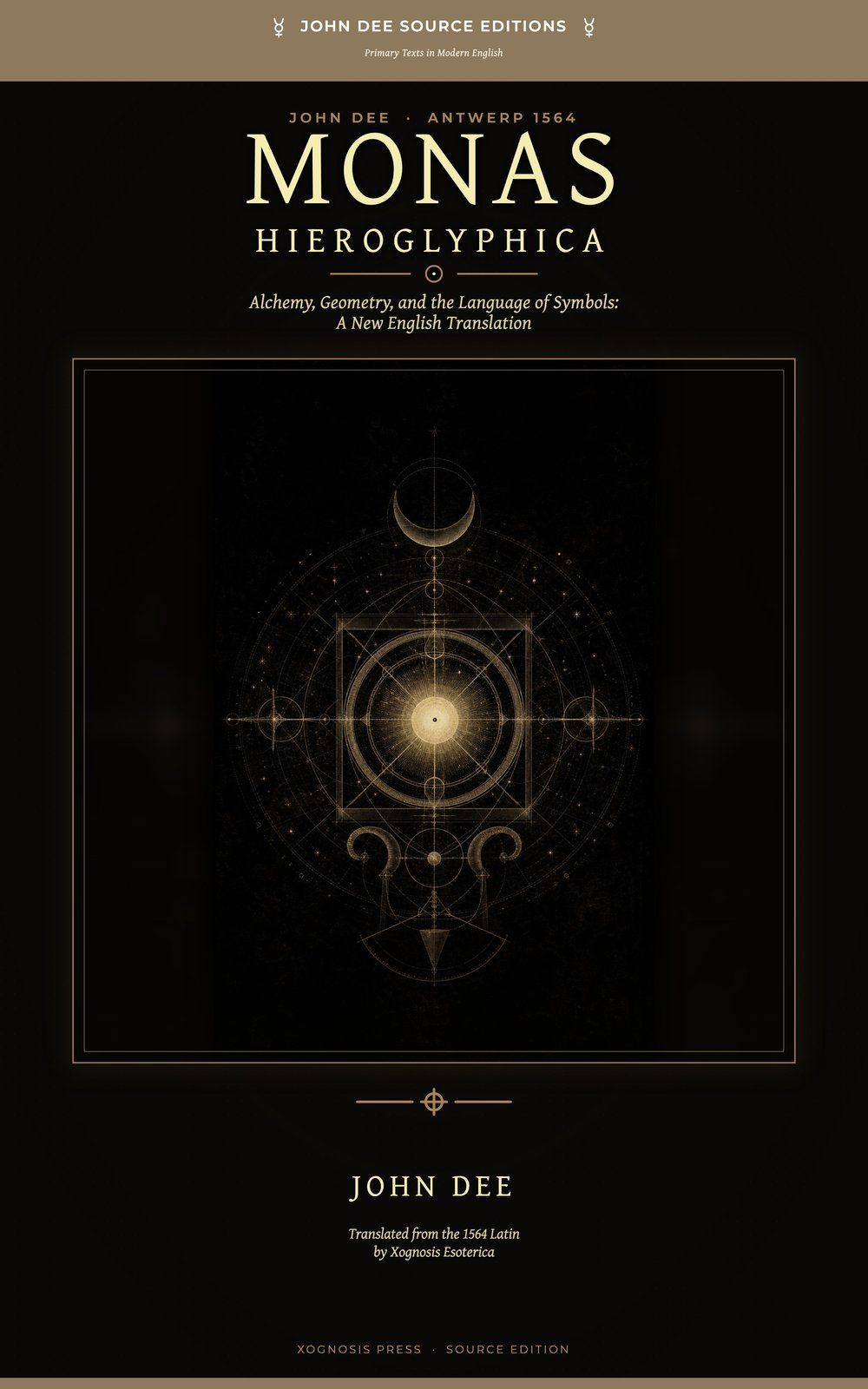
Readers who want to test themselves against Dee's twelve days of work can do so in our edition of the Monas Hieroglyphica, which prints the text with the diagrams Dee supervised in Silvius's shop.
Read the book
Related Articles
Continue through articles sharing this topic.
Two books sit at the far ends of the esoteric shelf, and they answer the same question in opposite ways.
6 min read
In the summer of 1552, two of the most restless minds in Europe were, as far as anyone can tell, in the same city at the same time.
6 min read
Open a modern edition of A True and Faithful Relation and you meet a problem before you meet a single angel.
7 min read
Open a page of John Dee's Monas Hieroglyphica at random and you see a strange object: a single compound sign, part astronomical, part alchemical, drawn once…
6 min read