 Xognosis EsotericaArcane Publishing Studio
In 1570 a Londoner who made his living in trade published the first complete English translation of Euclid's Elements, and he did something strange with the eleventh book. Where Euclid defines the pyramid and other solids, Henry Billingsley had the printer paste paper slips onto the page, cut in the shape of triangles, which the reader…
Share
In 1570 a Londoner who made his living in trade published the first complete English translation of Euclid's Elements, and he did something strange with the eleventh book. Where Euclid defines the pyramid and other solids, Henry Billingsley had the printer paste paper slips onto the page, cut in the shape of triangles, which the reader could erect until the angles met and a solid stood up from the flat sheet. Fold the paper and geometry rises off the page. It is among the earliest known books with such devices, and it appeared in the commercial heart of London rather than a university town, printed by John Day, translated by a merchant, and prefaced by the renowned mathematician John Dee.
Billingsley is an obscure figure on purpose. He left no portrait, and even his birth year is unknown; we know he died on 22 November 1606. He studied at St John's College, Cambridge, and later at Oxford, then entered trade and became a wealthy Londoner, eventually serving as sheriff and then Lord Mayor of London. The standard image of the merchant-scholar, the man of business who pursues learning in the margins of a commercial life, fits him almost too well.
The hard evidence of his scholarship survived by accident. Princeton University Library holds Billingsley's own copy of the 1533 Basel Greek editio princeps of Euclid, bound together with a 1558 Latin edition bearing his signature. The margins are annotated in his hand. In 1879 the mathematician G. B. Halsted identified the copy and published a note on it in the American Journal of Mathematics, where he remarked, in a line later historians love to repeat, "I dare hazard that no Lord Mayor, since his time, has ever written so charming a hand." Halsted also endorsed the conclusion Augustus De Morgan had reached earlier: "It was certainly made from the Greek, and not from any of the Arabico-Latin versions." The Cambridge Digital Library's account of their copy adds that Billingsley worked mainly from the Greek text, with corrections drawn from Zamberti's Latin.
The full title is a lesson in Renaissance publishing: The Elements of geometrie of the most auncient philosopher Euclide of Megara. The title page is wrong. It confuses Euclid of Alexandria, the geometer, with Euclid of Megara, a follower of Socrates who had died decades before the geometer was active. This was a common Renaissance error, and it tells us something about the market the book was reaching: readers who wanted Euclid's authority and did not yet have the scholarly apparatus to distinguish one ancient Greek name from another.
The translation covered all fifteen books of the Elements, the first English version to do so. It was a large folio, dense with diagrams; Christie's describes "geometrical diagrams throughout", with thirty-seven in Book XI carrying overslips, while the Linda Hall Library speaks of sixty folding figures across the same book. The tallies count different things, diagrams against individual paper pieces, and many surviving copies have lost a few either way. No source gives a verified page count or print run, so any picture of Day's costs and sales would be invention. What the record does support is the scale of the undertaking.
John Day, whose life dates Christie's gives as 1522 to 1584, is remembered by the Clark Library's Tudor collection as "the finest printer in England at the time, and one singularly capable of taking on the large and complex task of printing Euclid." Christie's puts it more plainly: printing "such a large folio, complete with its folding overslips, was a monumental task." A folio of this size, diagrammed on nearly every page, with paste-on flaps that had to be assembled by hand for each copy, tied up type, paper, and labor on a bet that enough English readers wanted geometry in their own tongue.
That was the real gamble. Latin editions of Euclid had circulated for centuries; the Greek text had been printed since 1533. A vernacular Elements assumed an audience that read English but not Latin well enough to study mathematics, a merchant class and a generation of practical men who needed geometry for surveying, navigation, and building. The book's existence is evidence that Day and Billingsley believed that audience was real. Framing the print run as a commercial risk is an interpretation supported by the printers' own scale, but no balance sheet survives, and honest accounts should say so.
The folding solids are the book's famous trick, and Billingsley explained it himself, on the page defining the pyramid, in spelling that stops the modern eye:
"Although the figure of a Pyramis can not be well expressed in a playne superficies, ... And yet that the reader may more clerely see the forme of a Pyramis, I have here set two sundry Pyramids which will appeare bodilike, if ye erecte the papers wherein are drawen the triangular sides of eche Pyramis, in such sort that the pointes of the angles F of ech triangle may in every Pyramis concurre in one point, and make a solide angle: one of which hath to his base a fower sided figure, and the other a five sided figure."
Read the instruction slowly and you can see the teacher at work. He knows the flat page fails the solid, he knows the novice reader cannot yet hold a pyramid in the mind's eye, and he solves it with scissors and paste. The Cambridge Digital Library reads the edition as aimed at novices, citing his repeated warnings that visualising solids from a flat page is hard; that is scholarly interpretation, offered by the librarians, and it fits what the pop-ups imply. Calling the book "the first pop-up book," as popular accounts often do, overshoots. What can be claimed is more careful: dozens of folding solids, and a place among the earliest known books with such devices.
One legend deserves a plain death. In the nineteenth century De Morgan suggested that John Dee, who wrote the book's long Mathematicall Praeface, had in fact done the translation. Dee's own correspondence already contradicted this: only the preface and supplementary material were his. Billingsley's annotated Greek copy at Princeton closes the case, since it shows a translator working directly from the Greek with his own hand.
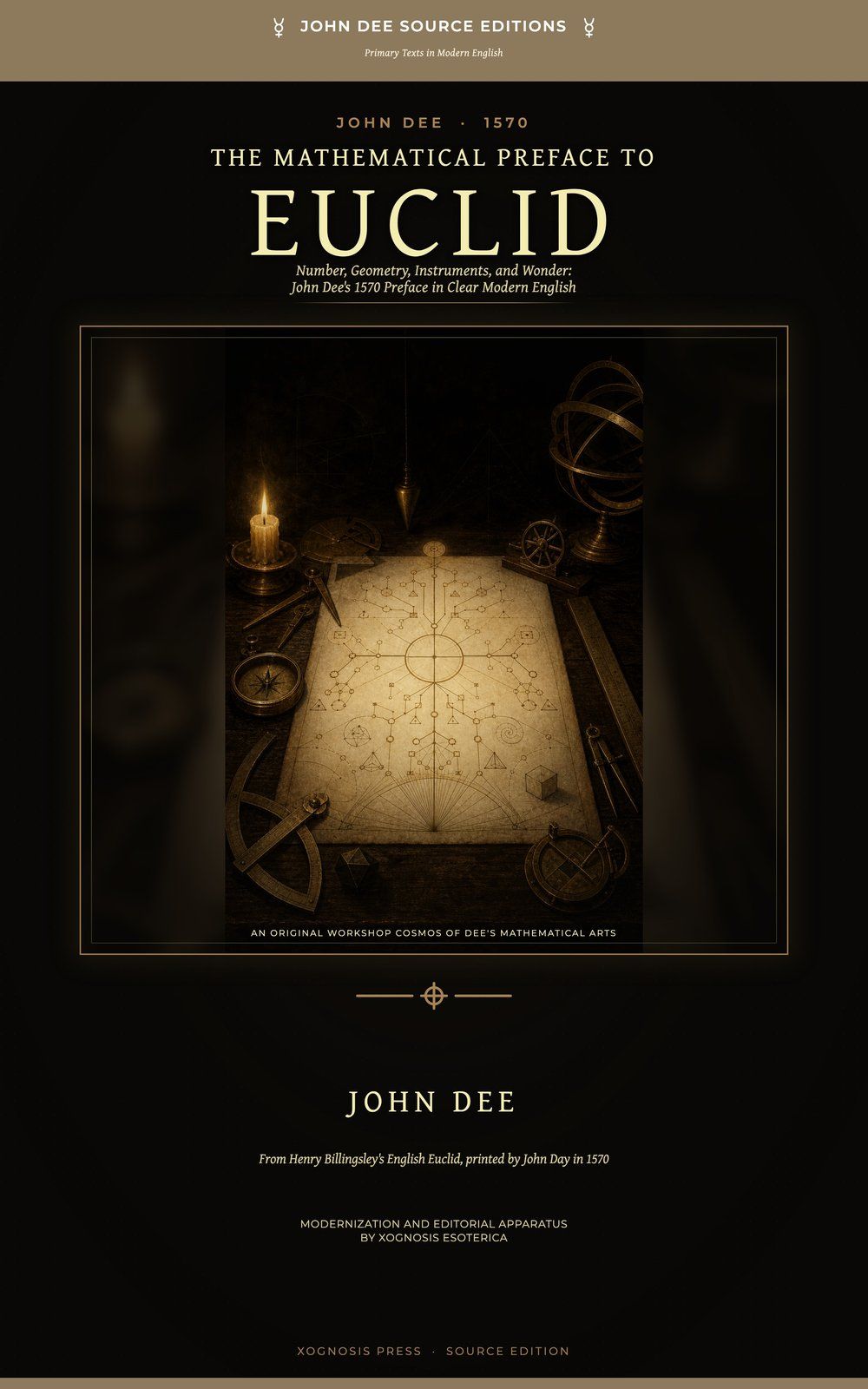
Dee's preface, which surveys the branches of pure and applied mathematics and adds notes of his own throughout the volume, is a remarkable document in its own right, a map of the mathematical sciences drawn for English readers at the moment the language was absorbing them. Christie's catalogue, quoting the historian E. G. R. Taylor, credits it with having "established Dee's intellectual leadership among English mathematical practitioners for three generations or more." Readers who want to meet it directly can find it in our edition of The Mathematical Preface to Euclid.
The deeper story of the London mathematical community around Dee, the practitioners and instruments and correspondence networks, remains unresearched in the sources gathered here. What the verified record gives us is narrower and still satisfying: a merchant who translated Euclid from the Greek, a printer bold enough to manufacture it, and paper pyramids that rise from the page four and a half centuries later when you lift them.
Read the book
Related Articles
Continue through articles sharing this topic.
There is a story about alchemy that almost everyone knows. For centuries, so it goes, clever men wasted their lives stirring molten metals and muttering…
6 min read
Ask most people who Jabir ibn Hayyan was and you will get a biography with the confidence of an encyclopedia entry: born at Tus in 721, son of a druggist,…
6 min read
Somewhere in Europe, probably in Italy, in the first decade of the fourteenth century, an alchemist sat down and wrote one of the most detailed laboratory…
6 min read
In the spring of 1576, a forty-eight-year-old mathematician named John Dee spent his days on board a cluster of ships tied up on the Thames, teaching…
6 min read