 Xognosis EsotericaArcane Publishing Studio
Modern readers who meet John Dee through legend expect a magician. The man who allegedly spoke with angels, folded into every story about Elizabethan occultism, seems an unlikely place to look for a theory of what numbers are.
Share
Modern readers who meet John Dee through legend expect a magician. The man who allegedly spoke with angels, folded into every story about Elizabethan occultism, seems an unlikely place to look for a theory of what numbers are. Yet in 1570, more than a decade before the angelic conversations that fixed his legend, and six years after his strangest book, Dee wrote one of the clearest statements of mathematical ontology in the English language. It sits at the front of somebody else's book.
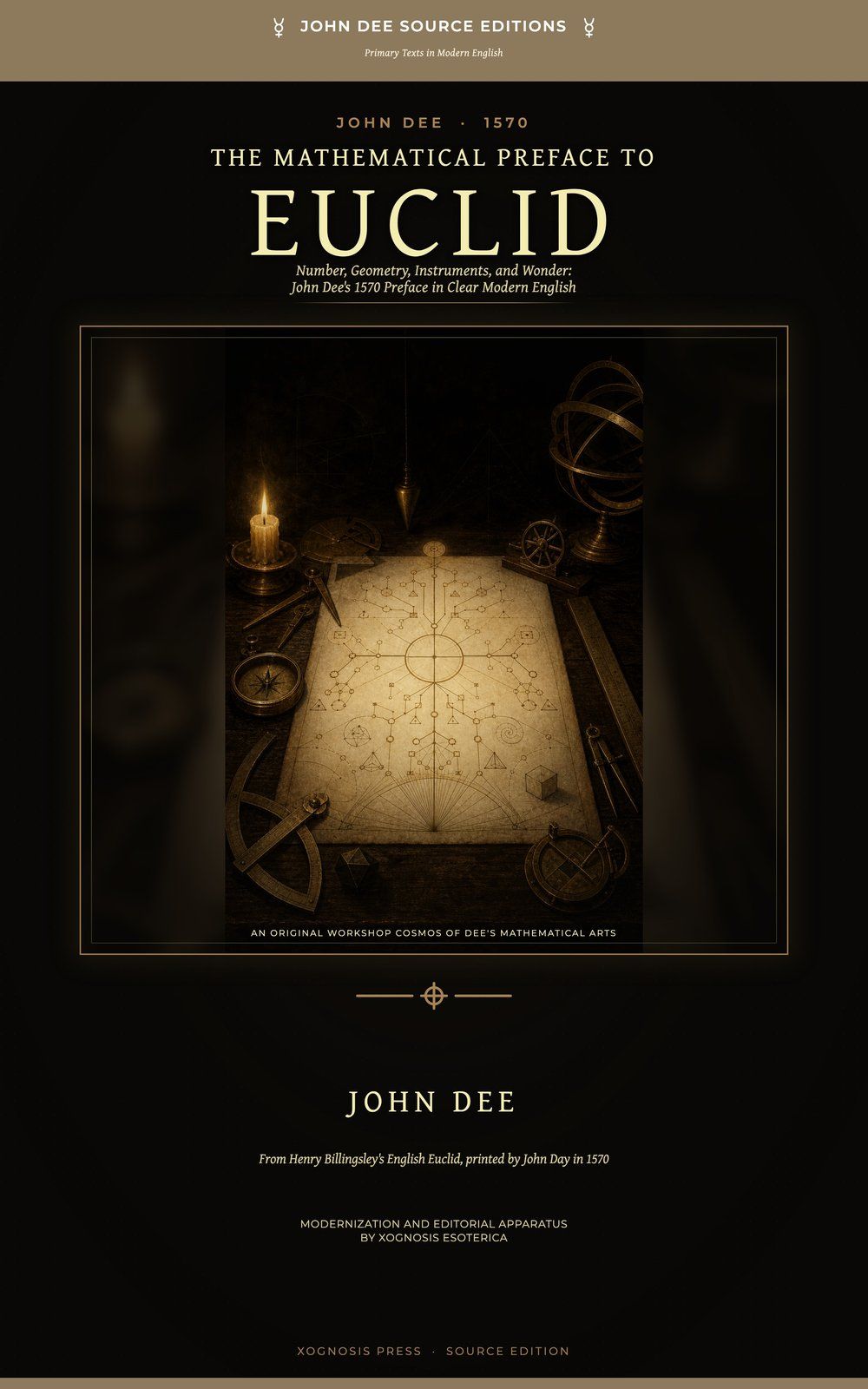
That year the London printer John Day published Henry Billingsley's English translation of Euclid's Elements. To it Dee contributed a long preface, the Mathematicall Praeface, which spends its opening pages doing something a modern preface never does: it defines what a number is, what a magnitude is, and what kind of existence these things enjoy. Our edition of The Mathematical Preface to Euclid presents this material in modern English. The definitions are worth slowing down for. They are the ground on which the rest of the Preface's programme stands, and, as we argue below, the best lens for the strange symbol of his 1564 Monas.
Dee's scheme begins with a division. "Number, we define, to be, a certayne Mathematicall Sũme, of Vnits." And what is a unit? In the original spelling: "an Vnit, is that thing Mathematicall, Indiuisible, by participation of some likenes of whose property, any thing, which is in deede, or is counted One, may resonably be called One." The mark over the u in "Sũme" is a printer's abbreviation for "um". Quotations in this article keep Dee's 1570 spelling throughout.
Notice the structure. A unit is not the number one in your counting. It is the mathematical thing whose likeness lets anything at all be called one: one chair, one thought, one hour. Number is then a sum of these. Alongside number stands its sibling. "Magnitude is a thing Mathematicall, by participation of some likenes of whose nature, any thing is iudged long, broade, or thicke." Magnitude does the same work for extension that the unit does for count. Your table is long because it participates in the likeness of magnitude; magnitude itself is not the table.
Arithmetic and geometry fall out of this pairing as the two principal mathematical sciences, arithmetic named first, geometry described in the Preface as its next sister, the "Absolute Science of Magnitudes." One science handles the indivisible, the other the continuous. That much Dee inherits from a long tradition. His own move comes when he asks where these things live.
The load-bearing passage arrives early in the Preface. Mathematical things, Dee writes, are "beyng (in a maner) middle, betwene thinges supernaturall and naturall: are not so absolute and excellent, as thinges supernatural: Nor yet so base and grosse, as things naturall: But are thinges immateriall: and neuerthelesse, by materiall things hable somewhat to be signified."
This is Dee's stated position, printed in 1570, not a reconstruction by later commentators. Number and magnitude are immaterial. They outrank bodies, which are gross, and fall short of the supernatural, which is absolute. And they have a peculiar double talent: they cannot be seen, yet material things can signify them. Draw a circle in ink and the ink is not magnitude, but the ink shows it.
Readers of later Neoplatonism will hear an echo of Proclus, who also placed mathematical objects between thought and being. That comparison is legitimate scholarly territory, but it is an interpretation, and we flag it as such; the research behind this article did not verify a Proclus edition, and the Preface itself makes no mention of him in these definitions. What the text asserts on its own is enough: mathematics studies a real intermediate order of being, and that order is accessible through the senses.
The Preface is famous for its catalogue of mathematical arts, laid out in the diagram Dee calls the Groundplat: navigation, surveying, architecture, music, astronomy, and more, each hanging from the trunk of arithmetic or geometry. The catalogue only makes sense given the ontology. If number were a trick of notation, or magnitude a property of sticks and stones, then the derived arts would be crafts of notation and sticks. Because mathematical things are middle things, immaterial yet signifiable by the material, the arts that apply them are applications of a real intermediate order to the world. Measuring a field becomes an encounter between magnitude-in-itself and a particular field.
The Preface presents this programme as practical and pedagogical. It offers England a curriculum. Any claim that the Groundplat secretly foreshadows Rosicrucianism is later legend or later interpretation, not something the text says, and it should not be presented as Dee's intention.
Dee's Monas Hieroglyphica appeared in Antwerp in 1564, six years before the Preface. The book compresses its teaching into twenty-four theorems built around a single composite symbol: planetary and elemental signs fused with the plainest items of geometry, line and circle, in one figure. Our modern-English Monas Hieroglyphica translates the 1564 Latin in that theorem order.
Here is the argument the chronology invites, and it is an argument, an interpretation rather than a fact Dee states anywhere: the Monas presupposes the ontology the Preface would later print. A symbol built from line and circle is built from the primitive items of magnitude. When the Monas claims its figure carries celestial and terrestrial significance at once, it can do so precisely because mathematical things are middle things, below the supernatural, above the natural, and signifiable by material marks, including ink on a page and, Dee would add, the glyphs of the planets. The Monas without the ontology is a curiosity. With it, the hieroglyph is a mathematical object doing middle-order work, mediating between levels of reality by means of its geometric parts.
That reading stays within what the two books themselves support. The angelic conversations of Dee's later life, from the 1580s onward, postdate both works, and belong to biography rather than to the ontology of 1570. They are regularly used to read the Monas backwards as magic; the Preface offers a cleaner lens.
It is tempting to translate "immaterial middle things" into a modern philosophy-of-mathematics question: was Dee a Platonist, a nominalist, a conceptualist? The Preface does not frame the question that way, and forcing it onto him flattens the text. His concern is architectural. He needs number and magnitude to be real enough that the arts depend on them, abstract enough that they exceed any one application, and signifiable enough that a book can teach them. The middle position is engineered for that job, and it is stated in plain declarative English within a few leaves of a printing that includes one of the oddest signature sequences in Elizabethan publishing: a pointing finger, then an asterisk, then a through c, then A.
Dee's answer, in his own words, is that number and magnitude are immaterial things, "middle, betwene thinges supernaturall and naturall," too real to be mere notation and too mediating to be divine: the ground on which every mathematical art in his catalogue stands.
If you want the whole architecture in one sitting, read the Preface first and the Monas second. The sequence matters less than the ground: with the definitions in place, both books stop being curiosities and become parts of one programme.
Read the book
Related Articles
Continue through articles sharing this topic.
Two books sit at the far ends of the esoteric shelf, and they answer the same question in opposite ways.
6 min read
In the summer of 1552, two of the most restless minds in Europe were, as far as anyone can tell, in the same city at the same time.
6 min read
Open a modern edition of A True and Faithful Relation and you meet a problem before you meet a single angel.
7 min read
Open a page of John Dee's Monas Hieroglyphica at random and you see a strange object: a single compound sign, part astronomical, part alchemical, drawn once…
6 min read